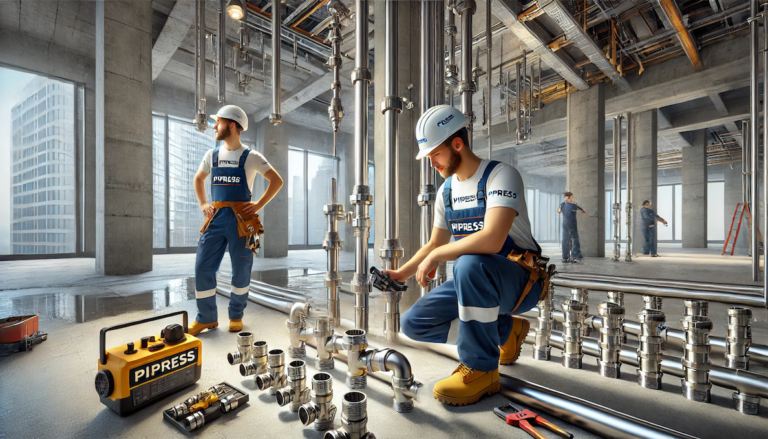

Tired of hot work permits and bulky gear for pipe joints? The time and risk of traditional methods add up. What if there was a faster, safer, flame-free way?
A press fitting is a flame-free pipe connection method.[^1] It uses a hydraulic tool to permanently crimp a fitting onto a pipe.[^2] An O-ring inside the fitting creates a [perfect, long-lasting seal](https://sti.srs.gov/fulltext/SRNL-STI-2012-00149.pdf)[^1][^3], making it a secure and fast alternative to welding or soldering.
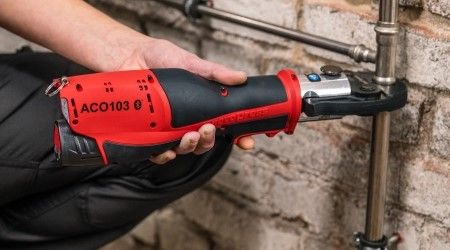
I've spent over 20 years in this industry, and I get the skepticism from seasoned pros. You're used to the certainty of a perfect weld or a tightly threaded joint. But the shift to "cold" press technology isn't just about convenience. It's a fundamental change in how we approach reliability and safety on the job site. Let's break down what that really means for someone who has seen it all.
Can a press fitting really replace the feel and fire of a weld?
You trust the heat and your own eyes to make a solid joint. A new tool that just "clicks" can feel uncertain. How can you be sure it's done right?
Yes, it can. Press fitting replaces the visual check of a weld with tactile and mechanical feedback. The press tool provides a [consistent, calibrated force every time](https://www.milwaukeetool.com/products/power-tools/plumbing-installation/press-tools)[^2][^4], and its cycle completion signal confirms a perfect joint[^3], removing the guesswork and human error common in welding.
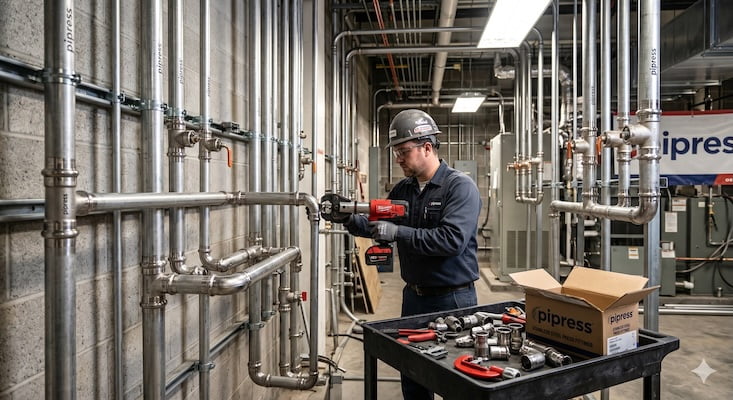
I remember a call-out to a high-end hotel. A leak repair was needed inside a finished suite. With welding, this job would have been a nightmare of paperwork and precautions. We would need to drain the system completely, get a hot work permit, disable smoke detectors, and post a fire watch[^5]. It would have taken hours before we could even strike an arc. Instead, we walked in with a pipe cutter and a battery-powered press tool. The system was isolated, but we didn't need it to be perfectly dry. We cut out the bad section and pressed in a new piece in under 10 minutes. No smoke, no fire risk, no angry hotel manager. That's the practical difference.
The Job Site: From Hazard Zone to Clean Zone
The biggest shift is in the work environment. Traditional methods introduce heat, fumes, and potential fire hazards.[^6] Press fitting is a cold-work process[^7], which completely changes the game. Think about the steps it eliminates. There's no need for gas bottles, hoses, or fire extinguishers. You can work in tight spaces, near sensitive materials, or on active systems without the same level of risk[^4]. This isn't just about speed; it's about making the job site fundamentally safer for everyone.
The "Feel": Trading Art for Science
A skilled welder can read the color and flow of the molten metal. It's an art form based on years of experience. Press fitting replaces that art with repeatable science. The "feel" you are looking for comes from the tool itself. When the tool completes its cycle, it gives a distinct click or automatically retracts its jaws.[^8] This is your confirmation. It tells you that the precise, engineered amount of force has been applied to create a permanent mechanical bond. It removes the variables of "was it hot enough?" or "did I get full penetration?". Every press is the same as the last.
| Feedback Method | Traditional Welding | Press Fitting |
|---|---|---|
| Confirmation | Visual check of the weld bead | Tool's audible/tactile cycle completion |
| Consistency | Depends on operator skill | Machine-calibrated and repeatable |
| Variable | Heat, gas flow, operator fatigue | Battery level, jaw condition (easily checked) |
| Trust | In your personal skill and experience | In the engineered system and tool |
How does a simple O-ring and squeeze create a permanent, leak-proof seal?
An O-ring for a permanent seal? It sounds temporary and weak. You're right to question if a piece of rubber can really hold up under pressure for decades.
The seal isn't just the O-ring. The press tool creates a permanent mechanical lock through metal deformation. The fitting and pipe are cold-formed together, creating immense grip. The high-performance EPDM or FKM O-ring is simply the sealing element, protected within this powerful mechanical joint.
(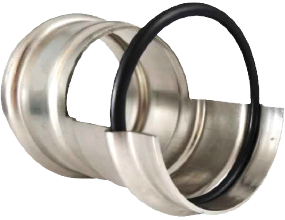
The biggest misunderstanding about press fittings is that the O-ring does all the work. That's not true. The O-ring is the seal, but the strength comes from the metal itself. Think about it like the head gasket in an engine. The gasket seals the combustion chamber, but it's the massive clamping force of the head bolts that holds everything together under extreme pressure. The press fitting works on a similar principle. The press tool acts like a powerful hydraulic wrench, permanently squeezing the fitting onto the pipe with tons of force, creating a bond that won't pull apart.
More Than a Squeeze: The Science of Cold Forming
When the press tool's jaws close on the fitting, they are not just pinching it. They are applying so much force that they permanently change the shape of both the fitting and the pipe underneath. This is called plastic deformation or cold forming[^5]. The stainless steel is forced into a new, hexagonal or polygonal shape that mechanically locks the two pieces together[^6]. This creates incredible resistance to being pulled apart or twisted. It's a permanent, non-reversible bond, formed without weakening the metal with heat.
The O-Ring: Built to Outlast the Pipe
The O-ring itself is not just any piece of rubber. It's a highly engineered component designed for a 50+ year service life[^7]. It sits in a protected groove, safe from UV light and physical damage. For different jobs, we use different materials.
| Seal Material | Common Name | Best For | Temperature Range |
|---|---|---|---|
| EPDM | Ethylene Propylene | Potable Water, Heating, Glycol | -20°C to 120°C (-4°F to 248°F)[^8] |
| FKM | Fluoroelastomer | Oils, Compressed Air, High Temps | -10°C to 200°C (14°F to 392°F)[^9] |
These materials are incredibly stable. MDPI - Aging Life Evaluation of O-Rings
NSF/ANSI 61 Standard for Drinking Water System Components
They don't break down or get brittle like you might fear. Lab tests, accelerated aging, and decades of real-world use have proven they maintain their elasticity and sealing power for the life of the piping system. SRNL - Aging Studies of EPDM
Are press fittings truly as strong and certified as traditional methods?
You follow the code and trust systems with a proven track record. A newer system needs more than promises. It needs proof that it meets or exceeds the standards you work with.
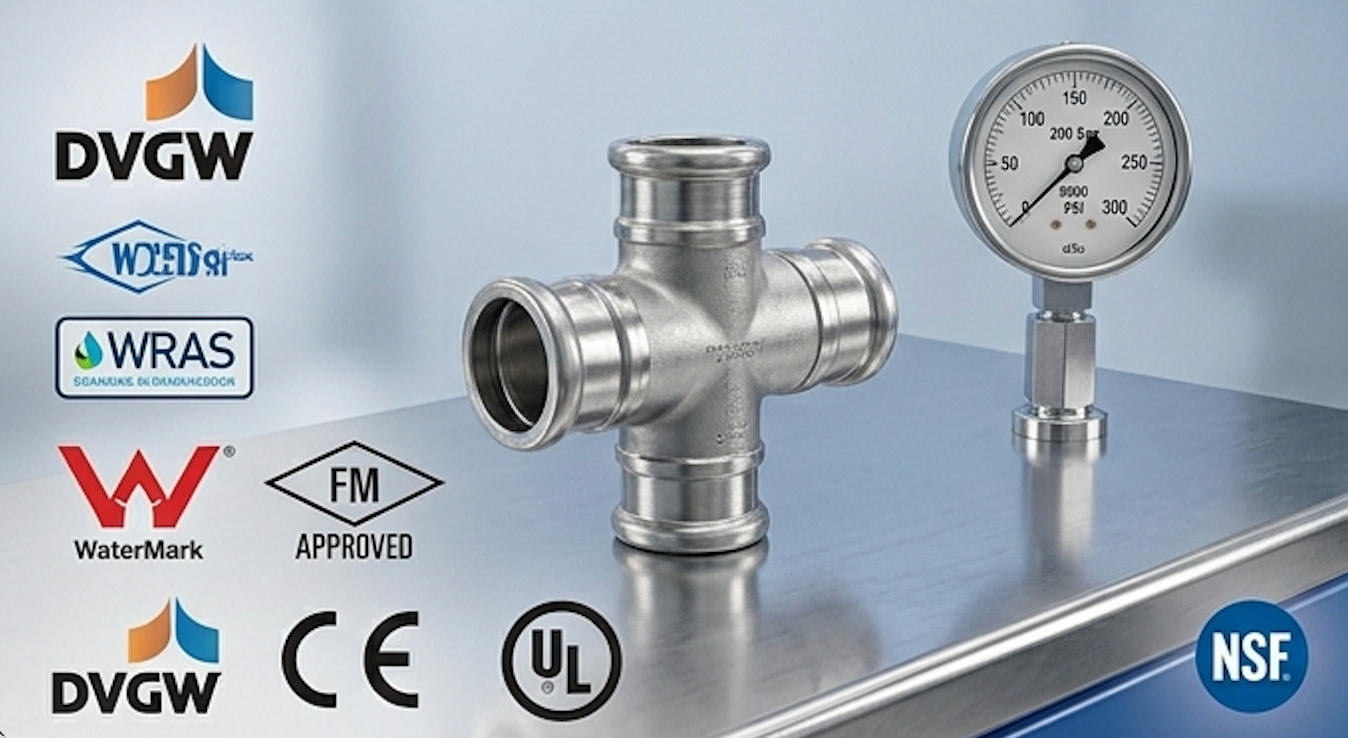
Absolutely. Press fittings undergo extreme testing for pull-out force, burst pressure, and vibration resistance[^10], often exceeding the requirements for welded or threaded joints. Certifications like [DVGW, WRAS, and ASME](https://engstandards.lanl.gov/esm/pressure_safety/Section%20REF-3-R0.pdf)[^11] are proof they meet the strictest international standards for safety[^9] and can be used in critical applications.
(
Talk is cheap. As a professional, you need to see the data and the approvals. I've stood in testing labs and watched these fittings get pushed to their absolute limits. We don't just test if they leak; we test them until they fail catastrophically, so we know exactly how strong they are. The numbers are consistently impressive. For example, a standard DN50 (2") stainless steel press fitting can often withstand a burst pressure of [over 200 Bar (3000 PSI)], which is many times higher than the operating pressure of any normal commercial or residential system.
The Numbers Don't Lie: Pull, Burst, and Shake Tests
Every fitting design is subjected to a brutal series of tests before it ever gets to a job site. These tests are defined by international standards bodies and are designed to simulate worst-case scenarios. They include hydraulic pressure tests that push the fitting to its bursting point and pull-out tests that measure the force required to pull the pipe out of the fitting. Press systems also perform exceptionally well in seismic and vibration tests, as the cold-formed joint can absorb energy better than a rigid threaded or welded connection.
What a Certification like DVGW or WRAS Really Means
When you see a certification mark like DVGW (for gas and water in Germany) or WRAS (for water in the UK), it's not just a marketing sticker. It's a legal and technical guarantee. It means the entire system—pipes, fittings, and seals—has passed independent, third-party testing for:
- Material Safety: The materials won't leach harmful chemicals into drinking water.
- Durability: The joint will last for decades without degrading, even under pressure and temperature changes.
- Performance: The connection meets or exceeds the pressure and flow requirements for its intended use.
This is why certified press systems are approved for critical applications like being buried in walls, embedded in concrete, or used for medical gas and sterile water lines in hospitals. The certification is your proof that the system is not just a convenience, but a reliable, long-term solution.
When should you NOT use a press fitting system?
No single solution is perfect for every job. Anyone who claims their product is flawless isn't being honest. Knowing a system's limits is as important as knowing its strengths.
You should not use standard press fittings for applications with extreme pressures, like over 40 Bar (600 PSI) in some industrial systems. They are also not suitable for highly corrosive chemical lines where specialized welded alloys are required. Always check the manufacturer's specifications.
 "Press Fitting Limitations")
Trust is built on honesty. I would never tell you to use a press fitting where it doesn't belong. While press systems are incredibly versatile and cover the vast majority of plumbing, heating, and compressed air applications, they have their limits. Acknowledging these limits is crucial for safety and for building your own credibility as an installer. If you know when to press and when to recommend a different method, you become a more valuable expert for your clients.
Know the Limits: Pressure and Media
The first limit is extreme pressure. While our fittings are tested to very high burst pressures, their rated operating pressure is typically around 16 Bar (232 PSI), with some systems going up to 40 Bar. For specialized industrial processes with pressures consistently above this, a heavy-duty welded or flanged system is still the right choice. The second limit is chemical compatibility. While our FKM seals are resistant to many oils and chemicals, they are not meant for highly aggressive acids or solvents. In those cases, a specialized polymer or welded alloy pipe system is necessary.
The Right Tool for the Job (And Why It Matters)
The final "limitation" is really about proper procedure. The system's reliability depends on using the correct, calibrated tool with the matching jaw profile.
- M-Profile vs. V-Profile: These are the two most common jaw profiles. They are not interchangeable. Using a V-profile jaw on an M-profile fitting (or vice-versa) will result in an incorrect press and a failed joint.
- First-Press Check: Before starting a job, it's good practice to make one test press on a scrap piece of pipe and fitting. Then, check it with a go/no-go gauge. This simple step confirms your tool is calibrated and you have the right jaws for the fittings you're using.
Being honest about these boundaries is how we maintain our reputation. We want you to be successful on every single job.
Conclusion
Press fittings offer a proven, certified, and fast alternative. Understanding how they work, and their limits, makes you a smarter installer and builds trust with your clients.
[^1]: "REVIEW OF AGING DATA ON EPDM O-RINGS IN THE ...", https://sti.srs.gov/fulltext/SRNL-STI-2012-00149.pdf. A technical standard or independent study on elastomeric seals in press-connect fittings can support that the O-ring provides the sealing function and that qualified elastomers can retain sealing properties under specified service conditions. Evidence role: mechanism; source type: institution. Supports: An O-ring inside a press fitting creates a durable seal.. Scope note: Such evidence would support sealing performance under tested conditions, but not the absolute claim that every seal is “perfect.” [^2]: "M18 and M12 FORCE LOGIC Plumbing Installation Press ...", https://www.milwaukeetool.com/products/power-tools/plumbing-installation/press-tools. A tool standard, laboratory evaluation, or manufacturer-independent technical document can substantiate that press tools are designed to apply a specified pressing force or complete a calibrated pressing cycle. Evidence role: mechanism; source type: institution. Supports: Press tools provide a repeatable, calibrated pressing force.. Scope note: This supports the tool’s designed repeatability, but actual force consistency still depends on maintenance, battery condition, jaw wear, and calibration intervals. [^3]: "[PDF] RP 240/RP 241 Press Tools", https://www.itm.com/pdfs/cache/www.itm.com/57363/manual/57363-manual.pdf?srsltid=AfmBOoqa2z8rjL21F0tlEOq87AOi44bsfKmh5pV7lhawLUOJsWNHufLo. A press-tool operating standard or technical manual can show that an audible, tactile, or automatic cycle-completion signal indicates that the tool has completed its pressing cycle. Evidence role: mechanism; source type: institution. Supports: The press tool’s completion signal indicates that the pressing cycle has finished.. Scope note: Cycle completion confirms tool operation, not independently that the joint is leak-free or “perfect”; inspection and pressure testing may still be required. [^4]: "1917.152 - Welding, cutting and heating (hot work)[12] (See ... - OSHA", http://www.osha.gov/laws-regs/regulations/standardnumber/1917/1917.152. Occupational safety guidance on hot work hazards can support that flame-free joining avoids ignition sources associated with welding, brazing, and soldering, reducing certain fire-control requirements in sensitive or confined work areas. Evidence role: expert_consensus; source type: government. Supports: Flame-free press fitting can reduce fire-related hazards compared with hot work in sensitive or constrained environments.. Scope note: This supports reduced hot-work fire risk, but does not prove that all active systems or confined spaces are safe for press fitting without job-specific controls. [^5]: "[PDF] Plastic Deformation in Materials Processing - MIT", https://web.mit.edu/janetryu/Public/Stamping.pdf. A materials-science reference can define plastic deformation and cold forming as permanent shape changes produced by mechanical stress below recrystallization temperature. Evidence role: definition; source type: education. Supports: The pressing action produces permanent deformation consistent with plastic deformation or cold forming.. [^6]: "Mechanical Analysis and Design of Press-Fit Interlocking Joints for ...", https://digitalcommons.latech.edu/dissertations/31/. A standard, patent, or independent technical paper on press-connect fittings can support that deformation of the fitting around the pipe creates a mechanical interlock while the elastomeric element provides sealing. Evidence role: mechanism; source type: paper. Supports: Cold deformation in a press fitting creates a mechanical lock between the fitting and the pipe.. Scope note: The exact geometry and locking mechanism vary by fitting profile and manufacturer. [^7]: "[PDF] REVIEW OF AGING DATA ON EPDM O-RINGS IN THE H1616 ...", https://sti.srs.gov/fulltext/SRNL-STI-2012-00149.pdf. An accelerated-aging study or certification standard for elastomeric sealing rings can support that properly selected EPDM or FKM seals may be qualified for multi-decade service under defined temperature, pressure, and media conditions. Evidence role: statistic; source type: paper. Supports: Press-fitting O-rings can be designed or qualified for service lives on the order of decades.. Scope note: Service-life estimates from accelerated aging are conditional and may not directly prove a 50-year life in every installation environment. [^8]: "[PDF] REVIEW OF AGING DATA ON EPDM O-RINGS IN THE H1616 ...", https://sti.srs.gov/fulltext/SRNL-STI-2012-00149.pdf. A polymer handbook, standards document, or materials database can support the typical operating-temperature range of EPDM elastomers used in water, heating, and glycol applications. Evidence role: statistic; source type: research. Supports: EPDM sealing materials are commonly rated for approximately -20°C to 120°C in relevant piping applications.. Scope note: Temperature limits depend on compound formulation, exposure time, pressure, and fluid chemistry; product-specific approvals may differ. [^9]: "Fluoroelastomer (FKM) Materials, Viton ... - Stockwell Elastomerics", https://www.stockwell.com/fluoroelastomer-fkm-materials/. A materials-science reference or standards-based elastomer compatibility guide can support that FKM fluoroelastomers are commonly used for oils and higher-temperature service compared with EPDM. Evidence role: statistic; source type: research. Supports: FKM sealing materials can be suitable for higher-temperature applications, with ranges commonly extending toward 200°C depending on formulation.. Scope note: The maximum temperature rating varies by FKM grade, medium, and continuous versus intermittent exposure. [^10]: "1-1/8" Press Fitting Hydrostatic Burst Test - YouTube",
. A press-fitting product standard or certification testing protocol can document that mechanical pipe joints are evaluated through pressure, tensile/pull-out, and cyclic or vibration-related performance tests. Evidence role: expert_consensus; source type: institution. Supports: Certified press fittings are tested for mechanical strength and pressure integrity, including pull-out, burst, and vibration-related performance.. Scope note: The required tests and acceptance thresholds vary by standard, pipe material, fitting size, and intended service. [^11]: "[PDF] ASME B31.3 Process Piping Guide - LANL Engineering Standards", https://engstandards.lanl.gov/esm/pressure_safety/Section%20REF-3-R0.pdf. Documentation from DVGW, WRAS, or ASME can establish that these bodies publish standards, approvals, or codes used to assess piping-system safety, water quality, pressure integrity, or installation requirements. Evidence role: historical_context; source type: institution. Supports: DVGW, WRAS, and ASME are recognized standards or approval bodies relevant to piping safety and performance.. Scope note: These organizations do not certify all press fittings for all uses; the specific product, material, size, and application must match the relevant approval or code scope.