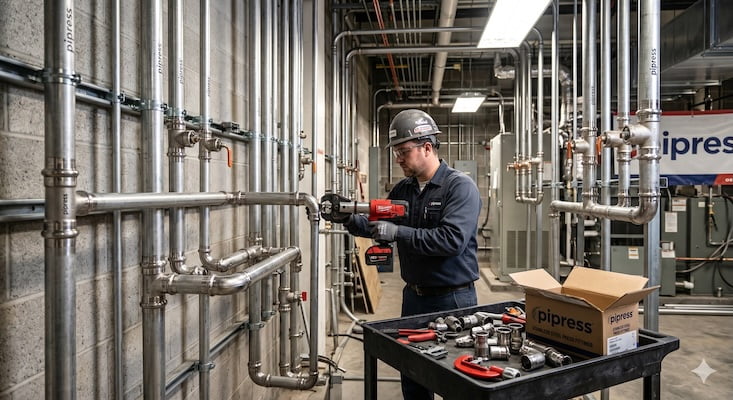


The Popularity of Stainless Steel Pipes and Press Fittings in the Semiconductor and AI Chips Industry
Introduction
The semiconductor industry, which encompasses the production of integrated circuits and microchips, is a cornerstone of modern technology. Within this sector, the manufacturing of AI chips represents a rapidly growing subset, driven by the demand for advanced computing power in artificial intelligence applications. These industries operate in highly controlled environments where precision, purity, and reliability are paramount. Stainless steel pipes and press fittings have emerged as preferred components in these settings due to their unique material properties and installation advantages. Stainless steel pipes are tubular structures made from alloys like 304 or 316 grades, known for their strength and resistance to environmental degradation. Press fittings, on the other hand, are mechanical connectors that join pipes through a cold-pressing process, eliminating the need for welding or soldering. This essay explores the reasons behind their popularity, focusing on material suitability, operational efficiency, and specific applications in semiconductor fabrication plants (fabs) and AI-related infrastructure.
Material Properties That Ensure Reliability and Purity
One primary reason for the widespread adoption of stainless steel pipes in the semiconductor and AI chips industry is their exceptional corrosion resistance. Semiconductor manufacturing involves handling aggressive chemicals, ultra-pure water, and specialty gases, all of which can corrode lesser materials. Stainless steel, particularly grades 316/316L, withstands these corrosive environments without degrading, preventing leaks that could contaminate sensitive processes. In cleanrooms—sterile facilities where chips are produced—any particle or impurity can ruin entire batches of semiconductors, costing millions. The smooth, non-porous surface of stainless steel minimizes particle adhesion and bacterial growth, maintaining the high purity levels required for wafer fabrication.
Durability under extreme conditions further enhances their appeal. Semiconductor processes often involve high pressures, temperatures, and thermal cycling, which stainless steel pipes handle effectively due to their mechanical strength and thermal stability. For AI chips, which are essentially advanced semiconductors optimized for machine learning tasks, the same principles apply during production. Moreover, in post-manufacturing applications like data centers housing AI systems, stainless steel pipes are used in cooling systems to manage the intense heat generated by high-performance GPUs and CPUs. This durability translates to longer service life, reducing the frequency of replacements and minimizing downtime in 24/7 operations.
Hygiene and compliance with industry standards also play a crucial role. Stainless steel is non-reactive and does not leach contaminants into fluids, making it ideal for transporting high-purity gases and liquids in semiconductor gas delivery systems. Electropolishing, a common treatment for stainless steel tubing in this industry, enhances surface smoothness and passivation, further preventing corrosion and ensuring chemical purity. Regulatory bodies and standards, such as those from SEMI (Semiconductor Equipment and Materials International), often mandate materials that meet these criteria, and stainless steel consistently complies.
Advantages of Press Fittings for Efficient Installation and Maintenance
Press fittings complement stainless steel pipes by offering a reliable, solder-free joining method that aligns perfectly with the demands of the semiconductor and AI chips industry. Traditional welding can introduce heat-affected zones, potential contamination from filler materials, and requires skilled labor, all of which increase costs and risks in cleanroom settings. Press fittings, installed using a hydraulic tool to compress the fitting onto the pipe, create leak-proof seals without heat or open flames. This is particularly advantageous in semiconductor fabs, where minimizing fire hazards and airborne particles is essential.
The speed of installation is a key factor in their popularity. Press fittings can be assembled in a fraction of the time required for welding, reducing labor costs and allowing for quicker system commissioning. In the fast-paced AI chips industry, where production ramps up to meet surging demand from tech giants, this efficiency helps fabs scale operations rapidly. For instance, in facility piping for air, water, and energy systems—known as AWE processes—press fittings enable modular designs that can be easily modified or expanded. Their compatibility with various pipe sizes and materials adds versatility, making them suitable for retrofitting older systems without major overhauls.
Reliability under operational stress is another benefit. Press fittings form tight, vibration-resistant joints that maintain integrity in high-pressure applications, such as chemical distribution lines in chip manufacturing. In AI data centers, where liquid cooling is increasingly adopted for direct-to-chip (D2C) systems, press fittings in stainless steel manifolds ensure secure connections for coolant flow, preventing leaks that could damage expensive hardware. This leak-proof design not only enhances safety but also supports sustainability by reducing fluid waste.
Applications in Semiconductor Fabrication and AI Infrastructure
In semiconductor fabs, stainless steel pipes and press fittings are integral to multiple systems. They transport ultra-pure water for wafer cleaning, specialty gases for etching and deposition, and chemicals for photolithography. For AI chips, which require even finer process nodes (e.g., 3nm or below), the purity demands are heightened, making stainless steel indispensable to avoid defects that could impair AI performance.
Beyond manufacturing, the AI chips industry extends to deployment in data centers, where stainless steel piping supports advanced cooling solutions. As AI workloads generate unprecedented heat densities—up to 1kW per chip—traditional air cooling is insufficient, leading to the adoption of liquid cooling. Stainless steel pipes in coolant distribution units (CDUs), manifolds, and pumps provide corrosion resistance against various coolants, ensuring long-term reliability in hyperscale facilities. Press fittings facilitate the assembly of these complex systems, allowing for scalable designs that accommodate growing AI server racks.
Economically, these components offer long-term cost savings. While initial material costs may be higher than alternatives like copper or plastic, the reduced maintenance, lower failure rates, and extended lifespan offset this. Environmentally, stainless steel’s recyclability aligns with the industry’s push toward sustainable practices, as fabs and data centers face scrutiny over resource consumption.
Conclusion
Stainless steel pipes and press fittings have become popular in the semiconductor and AI chips industry because they address the sector’s core challenges: maintaining purity, ensuring reliability, and optimizing efficiency. Their corrosion resistance, durability, and hygienic properties make them ideal for handling sensitive materials in fabs, while the quick, contamination-free installation of press fittings supports agile operations. In AI-specific contexts, such as data center cooling, they enable the infrastructure needed for high-performance computing. As the industry evolves with advancements like smaller nodes and more powerful AI systems, these components will likely remain essential, driving innovation while minimizing risks and costs.
PiPress has rich experience in supplying its PiPress inox press fitting pipe system in the Semiconductor and AI Chips Industry. Please contact PiPress team for professional suggestions and solutions.